For Cafés, Restaurants and Offices in the UK
Choosing the right Italian espresso blend for cafés, restaurants and offices is one of the most commercially important decisions a hospitality business can make.Espresso is not just another drink on the menu. It is the base of every coffee served, from flat whites to cappuccinos, and it shapes how customers judge quality, consistency, and professionalism.
This article builds on the foundations covered in our guide to private label coffee in the UK and the comparison between supply models in private label coffee or wholesale coffee. Here, the focus is narrower and more practical: selecting the right Italian-style espresso blend for real-world service.
Why Espresso Blend Choice Matters More Than Origin Stories
In hospitality environments, espresso must perform under pressure. Machines vary, staff skill levels differ, and service conditions change throughout the day. An espresso blend that works perfectly in theory but fails during busy periods quickly becomes a liability.
For this reason, most cafés and restaurants prioritise performance over novelty. The right blend delivers stable extraction, reliable crema, and a flavour profile that works both as a straight espresso and as the base for milk-based drinks.
This is why Italian-style espresso blends remain the standard choice for many UK businesses.
What Defines an Italian Espresso Blend
Italian espresso blends are designed for balance, body, and consistency. While styles vary slightly by region and roaster, they typically share several defining characteristics.
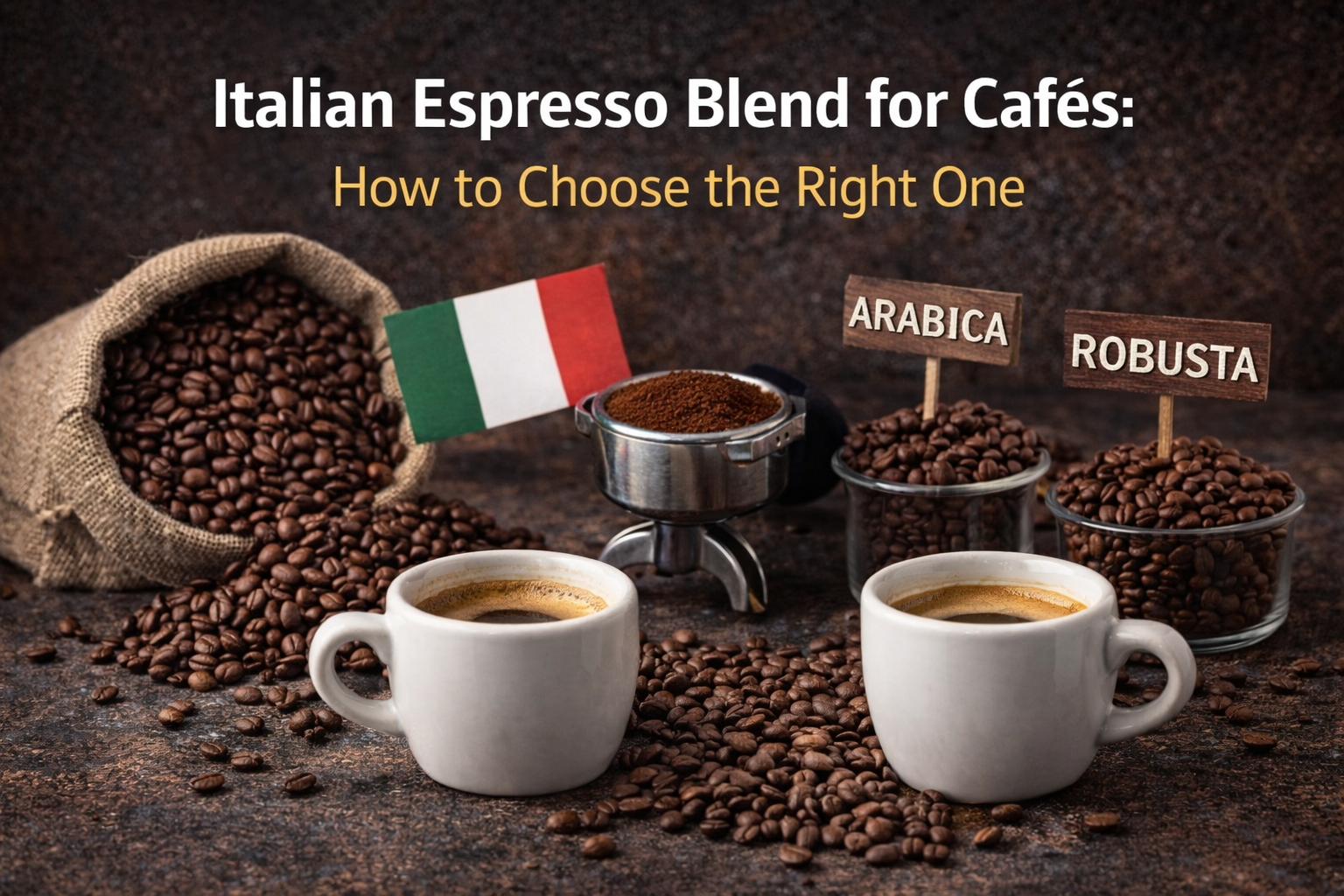
First, the roast profile tends to be medium-dark to dark. This develops chocolate, nut, and caramel notes while reducing acidity. Second, the blend often includes both Arabica and Robusta beans. Arabica provides aroma and sweetness, while Robusta contributes body, crema, and caffeine.
Finally, Italian espresso blends are formulated to be forgiving. They extract well across a range of grind settings and machines, making them suitable for busy service environments.
Arabica vs Robusta: Understanding the Balance
One of the most common misconceptions about espresso is that higher Arabica content automatically means higher quality. In reality, the balance between Arabica and Robusta matters more than the headline percentage.
Arabica beans bring sweetness, aroma, and complexity. However, on their own, they can lack body and crema, particularly in milk-heavy menus. Robusta beans, when used carefully, add strength, texture, and stability.
Many Italian espresso blends use an 80/20 or 70/30 Arabica-to-Robusta ratio. This balance produces an espresso that cuts through milk, holds its flavour, and remains consistent throughout the day.
Roast Level and Its Impact on Service
Roast level has a direct effect on extraction, flavour, and tolerance. Lighter roasts can be expressive but are often unforgiving. Small changes in grind or dose can result in sour or unbalanced shots.
Darker espresso roasts are more stable. They extract more easily, produce reliable crema, and deliver familiar flavour profiles that appeal to a wide audience. For cafés, restaurants, and offices serving a broad customer base, this stability is usually more valuable than experimental flavour notes.
This is one reason Italian-style espresso remains dominant in hospitality-focused private label supply.
Milk Compatibility: A Non-Negotiable Requirement
In the UK, the majority of espresso-based drinks include milk. Flat whites, lattes, cappuccinos, and americanos with milk account for most coffee sales outside specialist espresso bars.
An effective espresso blend must therefore retain its character when combined with milk. Chocolate and nut notes tend to integrate well, while high acidity can disappear or clash.
Blends developed for private label espresso supply are usually tested extensively for milk compatibility, ensuring consistent results across the menu.
Consistency Across Locations and Staff
For multi-site businesses or operations with frequent staff turnover, consistency becomes even more important. An espresso blend that requires constant adjustment increases training time and waste.
Italian espresso blends are designed to reduce this risk. Their forgiving nature allows different team members to achieve similar results, even with varying levels of experience.
This makes them particularly suitable for private label programmes aimed at hospitality businesses rather than hobbyist baristas.
Espresso for Offices and Workplace Environments
Offices and co-working spaces have different requirements from cafés, but consistency remains key. Coffee must be easy to prepare, appealing to a wide range of tastes, and reliable over time.
Italian-style espresso blends work well in bean-to-cup and semi-automatic machines commonly used in offices. Their balanced flavour profile reduces complaints and ensures broad acceptance.
For this reason, many workplace coffee programmes choose espresso blends similar to those used in hospitality.
How Private Label Supply Supports Espresso Consistency
When espresso blends are supplied through a private label model, consistency becomes part of the specification rather than an afterthought. The blend, roast profile, and production standards are set to meet the needs of the business using the coffee.
This approach differs from seasonal or rotating wholesale offerings, where blends may change regularly. For businesses that value stability, private label espresso supply provides a more predictable foundation.
Structured solutions such as private label wholesale Italian espresso coffee are designed around this principle, prioritising repeatability and performance.
Common Mistakes When Choosing an Espresso Blend
One common mistake is choosing a blend based solely on tasting notes without considering service conditions. Another is prioritising trend-driven flavours over customer expectations.
Businesses also sometimes underestimate the importance of milk performance or overestimate staff capacity for constant adjustment. These issues can all be avoided by selecting a blend designed specifically for hospitality use.
Matching the Blend to Your Business Type
Cafés focused on speed and volume benefit from blends that extract easily and hold flavour under pressure. Restaurants often prefer espresso that complements food rather than dominates it. Offices require reliability and broad appeal.
Italian-style espresso blends can be adapted to each of these environments while maintaining a consistent core profile.
Final Perspective
Choosing the right Italian espresso blend is not about chasing trends or showcasing obscure origins. It is about selecting a coffee that performs reliably, integrates with milk, and delivers a consistent experience to customers.
For cafés, restaurants, and offices in the UK, Italian-style espresso blends supplied through a private label model offer a practical balance of quality, consistency, and control.
When espresso is treated as a core product rather than an afterthought, it becomes a strength rather than a variable.