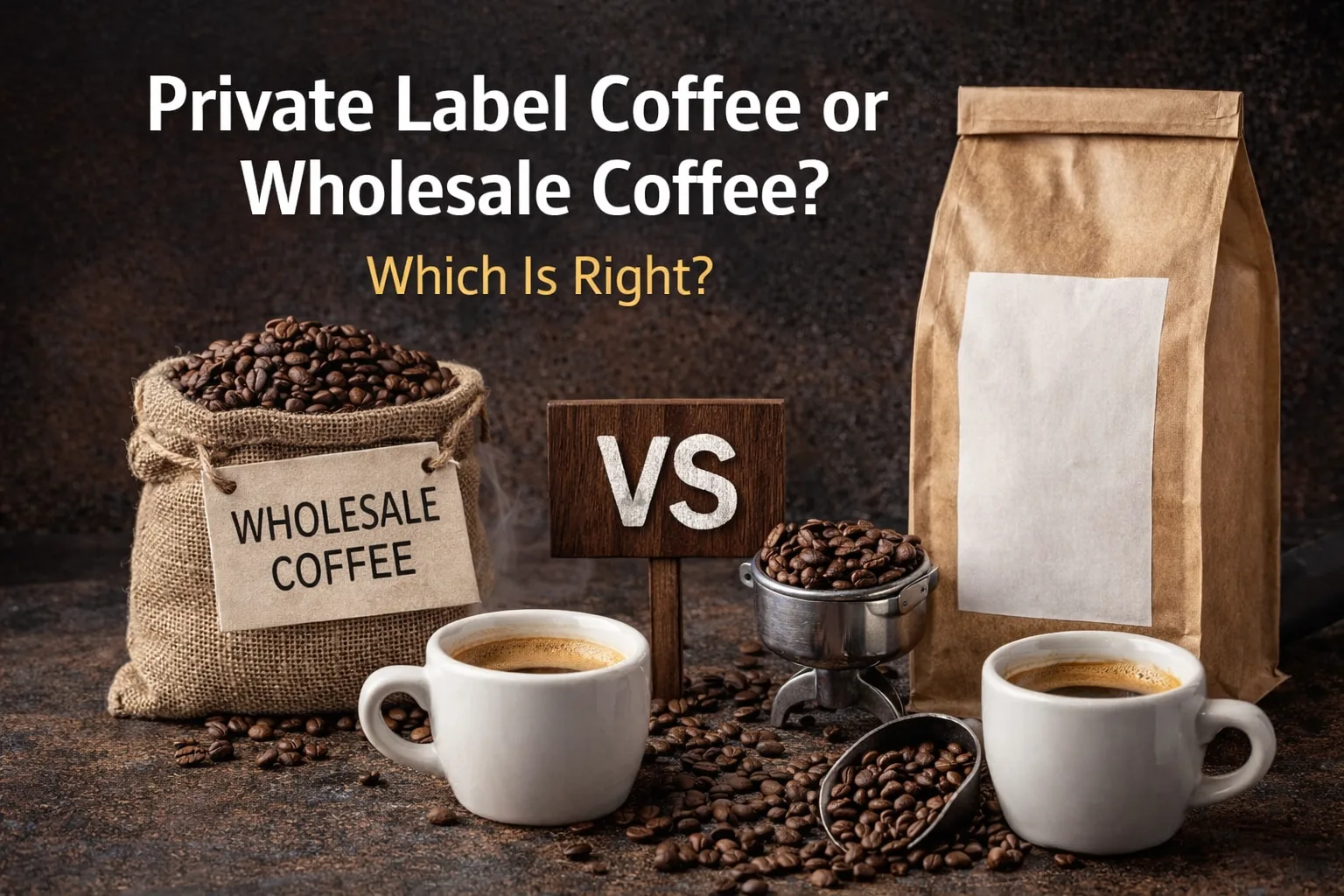
Which Is Right for Your Business?
Choosing between private label coffee and wholesale coffee is one of the most important decisions a café, restaurant, office, or hospitality brand will make. The choice affects not only cost and supply, but also branding, customer perception, and long-term growth.
Although the two models are often grouped together, they serve very different business goals. Understanding where each fits allows you to choose a supply structure that supports your operation rather than limits it.
This guide builds on the fundamentals explained in our complete guide to private label coffee in the UK and focuses specifically on how private label compares with traditional wholesale coffee supply.
What Wholesale Coffee Really Means
Wholesale coffee usually refers to purchasing roasted coffee that is branded, marketed, and positioned by the roaster. In this model, the roaster’s identity is visible to customers, often through packaging, menus, point-of-sale material, or even staff training.
This approach works well for businesses that want a recognised name behind their coffee with minimal decision-making. Equipment support, training, and promotional materials are often included, making wholesale coffee appealing to start-ups and venues that prioritise simplicity.
However, wholesale coffee also comes with limitations. Brand ownership remains with the supplier, margins are often fixed, and switching suppliers later can disrupt customer experience.
What Private Label Coffee Does Differently
Private label coffee removes the roaster from the customer-facing brand. The coffee is produced by a specialist supplier, but it is sold and presented under your business name.
This means the flavour profile, positioning, and identity of the coffee align directly with your brand rather than someone else’s. Customers associate the coffee with your business, not the producer behind it.
For many UK businesses, this approach provides a stronger foundation for growth, especially when consistency and brand recognition matter more than external logos.
Brand Control and Customer Perception
One of the clearest differences between private label and wholesale coffee lies in brand control. Wholesale coffee promotes the roaster. Private label coffee promotes you.
When customers see the same coffee brand in multiple venues, differentiation becomes harder. By contrast, private label coffee creates a unique association between flavour and business, reinforcing identity over time.
This distinction becomes increasingly valuable as businesses expand, open additional locations, or introduce retail coffee products.
Margin Structure and Commercial Flexibility
Wholesale coffee pricing is typically rigid. Costs are set by the roaster, and margins are influenced by brand positioning rather than your individual business model.
Private label coffee, on the other hand, allows more flexibility. Because the product is built for your business, pricing can be structured around volume, format, and usage. This is particularly relevant for businesses selling coffee retail, supplying offices, or operating multiple sites.
Structured supply models such as private label wholesale Italian espresso coffee are designed to balance cost control with consistent performance, making them well suited to hospitality environments.
Consistency, Training, and Service Reality
In real-world service conditions, consistency matters more than novelty. Wholesale coffee programs often change seasonally, which can require repeated dial-ins, retraining, and customer adjustment.
Private label espresso coffee is usually developed with stability in mind. The aim is repeatable flavour, reliable extraction, and minimal disruption during service.
For busy cafés and restaurants, this consistency reduces waste, improves workflow, and delivers a more predictable customer experience.
Equipment Tie-Ins and Operational Freedom
Many wholesale coffee agreements include equipment tie-ins or usage expectations. While this can be helpful initially, it may restrict flexibility as the business evolves.
Private label coffee supply is typically independent of equipment contracts. This allows businesses to choose machines, grinders, and service partners based on performance rather than obligation.
For operators who value control over their setup, this independence is a significant advantage.
Which Model Is Right for Your Business?
Wholesale coffee may be the right choice if your priority is speed to launch, minimal decisions, and leveraging an established roaster brand.
Private label coffee is better suited to businesses that value brand ownership, margin control, and long-term consistency. It is particularly effective for cafés, restaurants, offices, and hospitality brands that want their coffee to be part of their identity rather than a borrowed name.
Many UK businesses move toward private label as they mature, especially once they understand how coffee contributes to customer loyalty and brand perception.
Where Private Label Espresso Fits Best
Italian-style espresso blends are especially well suited to private label supply. Their balance, body, and milk compatibility make them reliable across a wide range of service environments.
This is why many businesses ultimately choose structured solutions such as private label wholesale Italian espresso coffee in the UK when transitioning away from branded wholesale supply.
Final Perspective
The choice between private label and wholesale coffee is not about right or wrong. It is about alignment.
If your goal is to build a recognisable brand, maintain consistency, and retain control over how your coffee supports your business, private label coffee offers a clear strategic advantage.
When implemented correctly, it transforms coffee from a background product into a long-term commercial asset.