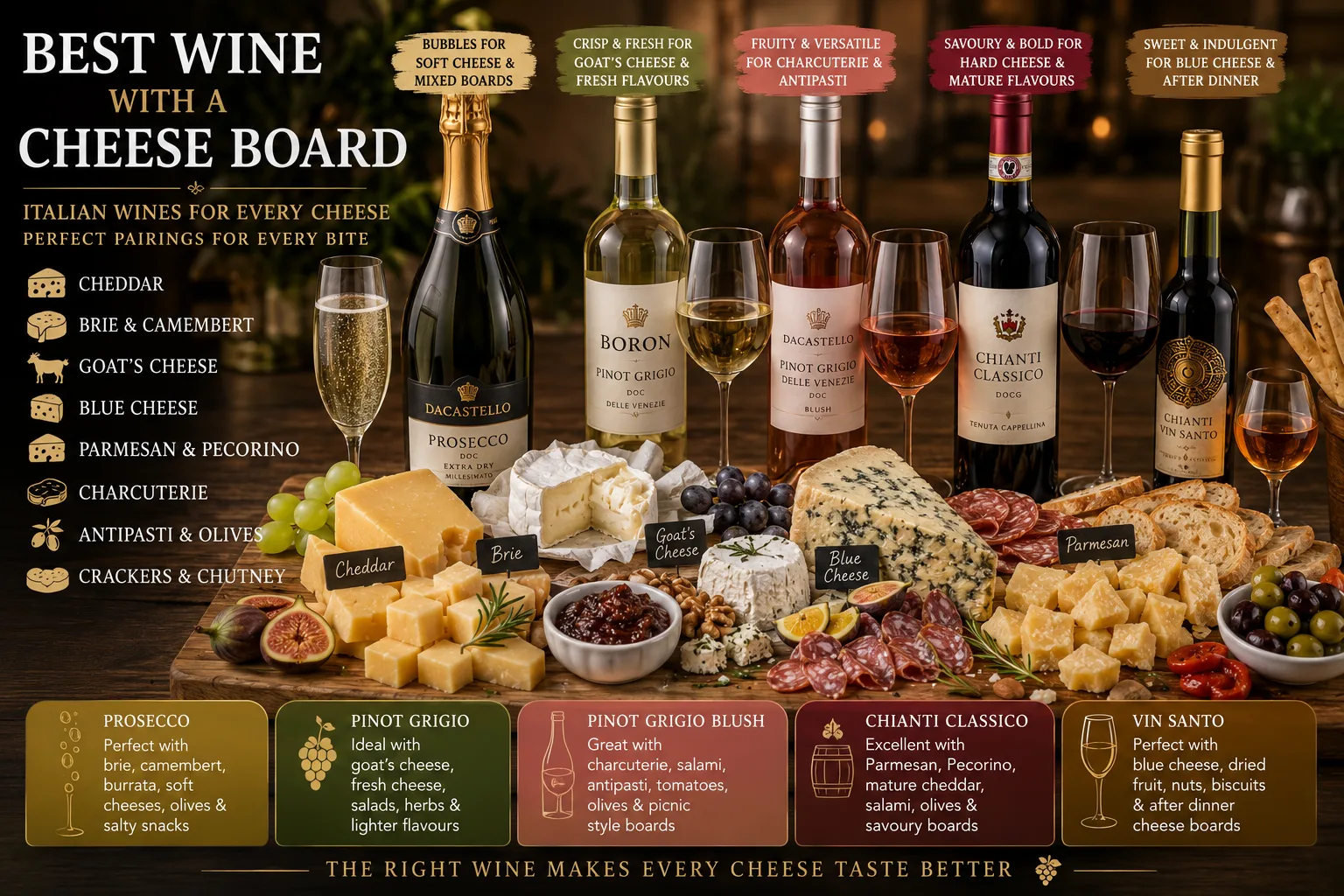
The best wine with a cheese board depends on what kind of cheese you are serving. A board with cheddar, crackers and chutney needs a different bottle from one loaded with brie, goat’s cheese, blue cheese, Parmesan, salami, olives and antipasti. Because cheese boards are full of salt, fat, creaminess, sharpness and richness, the right Italian wine can make the whole spread taste better.
A proper cheese board is one of the easiest ways to feed people well. It works for Friday nights, family gatherings, garden tables, Christmas, Boxing Day, birthdays, wine nights, picky bits, picnics and those “we don’t want a full meal” evenings. You can keep it simple with cheddar and crackers, or you can build a full Italian-style grazing board with cured meats, olives, tomatoes, bread, chutney, fruit, nuts and a few brilliant bottles.
However, cheese can be tricky with wine. Some cheeses love crisp white wine. Others need bubbles. Stronger cheeses can handle red wine, while blue cheese often needs something sweet or powerful enough to stand up to it. Therefore, the best approach is not to force one wine onto every cheese. Instead, choose the bottle that suits the main style of the board.
This guide is built for real UK cheese boards: cheddar, brie, blue cheese, goat’s cheese, soft cheese, hard Italian cheese, charcuterie, antipasti, crackers, chutney, olives and all the extras that end up around the board.
The simple rule for wine with cheese boards
The easiest rule is this: fresh wines work with creamy and salty cheese, while richer reds work with harder, stronger and more savoury cheeses.
Sparkling wine is brilliant with soft cheese, salty snacks and mixed grazing boards because the bubbles cut through richness. Crisp white wine works well with goat’s cheese, fresh cheeses, salads and lighter antipasti. Rosé is useful when the board includes charcuterie, soft cheeses, tomatoes, olives and picnic-style food. Meanwhile, red wine is best when the board has hard cheese, salami, mature cheddar, Parmesan, Pecorino or richer savoury flavours.
Sweet wine also has a place. If the board includes blue cheese, biscuits, dried fruit, nuts or something more after-dinner, a dessert wine can be excellent. It sounds fancy, but the logic is simple: salt and sweetness work beautifully together.
Ultimately, a cheese board is about balance. You want the wine to refresh the mouth, soften the salt and bring out the flavour of the cheese without making everything feel heavy.
Shop the pairing: Italian wines for cheese boards
For this cheese board guide, these are the Donzella Wines bottles to put on the table:
Best sparkling wine for soft cheese and mixed boards: Dacastello Prosecco DOC Extra Dry Millesimato
Best crisp white for goat’s cheese and fresh cheese: Boron Pinot Grigio DOC delle Venezie
Best rosé for charcuterie, antipasti and casual cheese boards: Dacastello Pinot Grigio Blush
Best red for hard cheese, Parmesan, Pecorino and mature cheese: Chianti Classico DOCG Tenuta Cappellina
Best after-dinner cheese board wine: Chianti Vin Santo
If you only want one easy bottle for a mixed cheese board, start with Dacastello Prosecco DOC Extra Dry Millesimato. If the board is heavier, with hard cheese and cured meats, add Chianti Classico DOCG Tenuta Cappellina.
Best wine with cheddar
Cheddar is one of the most common cheeses on a British cheese board, but it can be surprisingly different depending on age. Mild cheddar is creamy and easy. Mature cheddar is sharper, saltier and more intense. Extra mature cheddar can be powerful enough to change the whole wine pairing.
For mild or medium cheddar, sparkling wine is a very good choice. Dacastello Prosecco DOC Extra Dry Millesimato has bubbles, freshness and a lightly fruity style, which helps lift the creaminess of cheddar and crackers. It also works well if the board includes soft cheese, grapes, apple slices, breadsticks or salted snacks.
For mature cheddar, a red wine often works better. Chianti Classico DOCG Tenuta Cappellina is a strong choice because it brings savoury character, acidity and enough structure for aged cheese. Mature cheddar has salt and depth, while Chianti has enough freshness to stop the pairing from feeling too heavy.
If the cheddar is served with chutney, pick the wine based on the chutney. A sweeter onion or tomato chutney can work well with Prosecco or rosé, while a sharper pickle-style chutney often suits Chianti better.
Best wine with brie and camembert
Brie and camembert are creamy, soft and rich. Because of that, they need a wine that can cut through the texture. A heavy red is not always the best answer, especially if the cheese is mild and buttery.
Sparkling wine is one of the easiest choices. Dacastello Prosecco DOC Extra Dry Millesimato works well because the bubbles refresh the palate after each creamy bite. It makes brie feel lighter and keeps the board lively.
Rosé also works, particularly if the brie is served with charcuterie, strawberries, tomatoes, olives or picnic-style food. Dacastello Pinot Grigio Blush brings soft fruit and freshness, which suits relaxed grazing boards.
If the camembert is baked with garlic, herbs or honey, Prosecco is still a strong choice. However, if you add cured meats, roasted peppers or savoury antipasti around it, rosé becomes even more useful.
Best wine with goat’s cheese
Goat’s cheese is tangy, fresh and often slightly earthy. It loves wine with acidity. Therefore, crisp white wine is usually the best place to start.
Boron Pinot Grigio DOC delle Venezie is a very good match for goat’s cheese because it is clean, dry and refreshing. It works especially well with fresh goat’s cheese, goat’s cheese salad, cucumber, tomatoes, grilled vegetables, herbs and lighter crackers.
If the goat’s cheese is served with honey, beetroot or roasted peppers, rosé can also be useful. Dacastello Pinot Grigio Blush gives you a little more fruit, which helps with sweeter or earthier flavours.
For very aged or firm goat’s cheese, you can move towards a lighter red or a savoury red. However, for most UK cheese boards with soft goat’s cheese, Pinot Grigio is the easiest and cleanest pairing.
Best wine with blue cheese
Blue cheese is bold, salty and powerful. Stilton, Gorgonzola, Roquefort-style cheeses and strong blue cheeses need a wine with enough personality to stand up to them. A delicate white can disappear, while some dry reds can taste bitter next to the salt and intensity.
One of the best routes is sweetness. Chianti Vin Santo is a great after-dinner option because sweet wine and salty blue cheese can be a brilliant combination. The sweetness balances the salt, while the richness of the wine matches the strength of the cheese.
If the blue cheese is part of a larger board with nuts, dried fruit, biscuits, figs, pears or honey, Vin Santo makes even more sense. It turns the cheese board into a proper end-of-meal moment.
For people who prefer dry red wine, Chianti Classico can work with milder blue cheeses, especially if the board also includes hard cheese, cured meats and savoury crackers. However, for strong blue cheese, Vin Santo is the more memorable match.
Best wine with Parmesan, Pecorino and hard Italian cheese
Hard Italian cheeses are brilliant with Italian red wine. Parmesan, Pecorino, Grana Padano and aged hard cheeses bring salt, savoury depth and a firm texture. They need wine with freshness, structure and enough flavour.
Chianti Classico DOCG Tenuta Cappellina is the standout choice here. Chianti and hard Italian cheese are natural partners because the wine has acidity, tannin and savoury fruit. The cheese softens the wine, while the wine refreshes the palate.
This is the bottle to open if your board includes Parmesan chunks, Pecorino, salami, olives, roasted peppers, bread, olive oil and antipasti. It also works well with mature cheddar, aged cheese and savoury crackers.
If the board is more casual and includes softer cheeses as well, you can still pour Prosecco or rosé at the start. Then, as people move towards the stronger cheeses, bring out the Chianti.
Best wine with mozzarella and fresh cheese
Mozzarella is soft, milky and delicate, so it does not need a heavy wine. In fact, a big red can overpower it completely. Fresh cheese usually works best with white wine, sparkling wine or rosé.
If the mozzarella is served simply with tomatoes, basil, olive oil and salt, Boron Pinot Grigio DOC delle Venezie is a strong choice. It keeps the pairing fresh and light, especially with Caprese-style flavours.
If the mozzarella is part of an antipasti board with cured meats, olives, roasted peppers and charcuterie, Dacastello Pinot Grigio Blush becomes more flexible. Rosé can handle the fresh cheese and the savoury extras.
For burrata, which is richer and creamier, Prosecco works very well. The bubbles in Dacastello Prosecco DOC Extra Dry Millesimato help cut through the creamy middle without overpowering the cheese.
Best wine with cheese and charcuterie
Many cheese boards are not just cheese. They also include salami, prosciutto, bresaola, mortadella, chorizo-style meats, olives, bread and antipasti. Once cured meat is on the table, the wine needs to handle salt, fat and savoury flavour as well as cheese.
For lighter charcuterie and soft cheeses, rosé is excellent. Dacastello Pinot Grigio Blush has enough fruit for cured meats, enough freshness for soft cheese and enough ease for a relaxed sharing board.
For heavier boards with salami, hard cheese, mature cheddar, Parmesan and olives, Chianti Classico DOCG Tenuta Cappellina is the stronger match. It brings savoury depth, acidity and structure, which works well with salt and fat.
Prosecco also has a role here. If the board is being served at the start of an evening, Dacastello Prosecco DOC Extra Dry Millesimato is a lovely first bottle. It wakes up the palate, suits soft cheese and works with salty snacks.
Best wine with antipasti and cheese boards
An Italian-style cheese board often becomes an antipasti board. That means cheese, cured meats, olives, tomatoes, roasted peppers, artichokes, focaccia, breadsticks, bruschetta, mozzarella, salami and olive oil. Because there are so many textures and flavours, you need flexible wines.
For a fresh antipasti board, choose Boron Pinot Grigio DOC delle Venezie or Dacastello Pinot Grigio Blush. Pinot Grigio works best when the board is lighter, with mozzarella, salad, tomatoes and fresh cheese. Rosé is better when the board has more cured meat, roasted peppers and charcuterie.
For a richer antipasti board, Chianti Classico DOCG Tenuta Cappellina is ideal. It works with hard cheese, salami, savoury crackers, olives and roasted vegetables.
If the board is being served before dinner, begin with Prosecco. If it is the main event, serve rosé and Chianti together so people can move between lighter and richer bites.
Best wine with cheese and chutney
Chutney changes everything. A cheese board with pickle, onion chutney, tomato chutney, fig jam, chilli jam or fruit preserve needs wine that can cope with sweetness and sharpness.
For sweeter chutneys, sparkling wine and rosé work well. Dacastello Prosecco DOC Extra Dry Millesimato has enough freshness to balance sweet chutney and creamy cheese. Meanwhile, Dacastello Pinot Grigio Blush works well when the chutney is fruitier or tomato-based.
For sharper pickle-style chutneys with mature cheddar, Chianti Classico is usually better. The savoury acidity in Chianti Classico DOCG Tenuta Cappellina can handle stronger cheese and tangier accompaniments.
If blue cheese is served with fig jam, honey or dried fruit, Chianti Vin Santo is the best after-dinner bottle.
Best wine with crackers, bread and olives
Crackers, bread and olives might seem like background food, but they affect the pairing. Crackers bring salt and crunch. Bread brings softness. Olives bring salt, bitterness and savoury depth. Therefore, the wine needs freshness.
Prosecco is excellent with salted crackers and olives because the bubbles refresh the palate. Dacastello Prosecco DOC Extra Dry Millesimato is especially good if the board is light, salty and snack-led.
Pinot Grigio works well when bread, olive oil, mozzarella, tomatoes and fresh cheese are involved. Boron Pinot Grigio DOC delle Venezie keeps everything clean and refreshing.
For black olives, hard cheese, salami and richer savoury bites, Chianti Classico is better. It has the structure to work with stronger flavours while still keeping the board balanced.
Should red wine be served with cheese?
Yes, red wine can be excellent with cheese, but it depends on the cheese. A common mistake is assuming all cheese needs red wine. In reality, soft and creamy cheeses often work better with sparkling wine, white wine or rosé.
Red wine is strongest with hard cheese, mature cheese, aged cheese, salami and savoury boards. That is why Chianti Classico DOCG Tenuta Cappellina is a strong cheese board red. It suits Parmesan, Pecorino, mature cheddar, antipasti and savoury cheese-board extras.
However, if the board is mostly brie, goat’s cheese, mozzarella and fresh cheese, go lighter. Prosecco, Pinot Grigio and rosé will usually do a better job.
Quick cheese board wine pairing guide
| Cheese board food | Best wine style | Donzella pick |
|---|---|---|
| Brie, camembert and soft cheese | Sparkling wine | Dacastello Prosecco DOC Extra Dry Millesimato |
| Goat’s cheese and fresh cheese | Crisp white wine | Boron Pinot Grigio DOC delle Venezie |
| Charcuterie and casual grazing boards | Dry rosé | Dacastello Pinot Grigio Blush |
| Parmesan, Pecorino and mature cheddar | Savoury Italian red | Chianti Classico DOCG Tenuta Cappellina |
| Blue cheese and after-dinner boards | Italian dessert wine | Chianti Vin Santo |
How to build a cheese board for Italian wine
A good cheese board does not need to be complicated. Start with three cheeses, then add salty, crunchy, fresh and sweet extras.
Choose one soft cheese, such as brie, camembert, mozzarella or burrata. Then add one hard cheese, such as mature cheddar, Parmesan or Pecorino. Finally, add one stronger cheese, such as blue cheese, aged cheese or firm goat’s cheese.
After that, build around the cheese. Add crackers or bread for crunch, olives for salt, grapes or figs for sweetness, nuts for texture, chutney for sharpness and cured meats for savoury depth.
If you are serving one bottle, match it to the strongest part of the board. For a soft, creamy board, choose Prosecco. For a fresh and tangy board, choose Pinot Grigio. For charcuterie and antipasti, choose rosé. For hard cheese and mature cheddar, choose Chianti. For blue cheese after dinner, choose Vin Santo.
The best all-round wine with a cheese board
If you want one bottle that works with the widest range of cheese-board food, choose Dacastello Prosecco DOC Extra Dry Millesimato. It works with soft cheese, salty snacks, fresh salads, antipasti and light grazing food. The bubbles make it flexible, and the freshness keeps the board lively.
For a mixed summer cheese board with charcuterie, soft cheese, olives and picnic food, Dacastello Pinot Grigio Blush is probably the easiest bottle to share.
For a lighter cheese board with goat’s cheese, mozzarella, salads and fresh herbs, Boron Pinot Grigio DOC delle Venezie is the cleanest choice.
For a richer board with mature cheddar, Parmesan, Pecorino, salami, olives and savoury crackers, Chianti Classico DOCG Tenuta Cappellina is the best red.
Finally, for blue cheese, biscuits, dried fruit and an after-dinner finish, Chianti Vin Santo is the bottle that makes the board feel special.
Final bottle picks
For soft cheese, brie, camembert, burrata, olives and salty snacks, open Dacastello Prosecco DOC Extra Dry Millesimato. It is fresh, lively and ideal for a relaxed cheese board.
For goat’s cheese, mozzarella, Caprese-style food, salads and fresh cheese, open Boron Pinot Grigio DOC delle Venezie. It is crisp, clean and refreshing.
For charcuterie, antipasti, picnic boards and casual grazing, open Dacastello Pinot Grigio Blush. It is easy, fruity and flexible.
For mature cheddar, Parmesan, Pecorino, hard cheese and savoury Italian boards, open Chianti Classico DOCG Tenuta Cappellina. It brings freshness, structure and a proper Tuscan feel.
For blue cheese, biscuits, dried fruit, nuts and after-dinner cheese boards, open Chianti Vin Santo. It turns a simple cheese board into a finishing course.
A cheese board should feel generous, relaxed and full of choice. With the right Italian wine on the table, it becomes more than a few bits of cheese and crackers. It becomes a proper sharing moment.