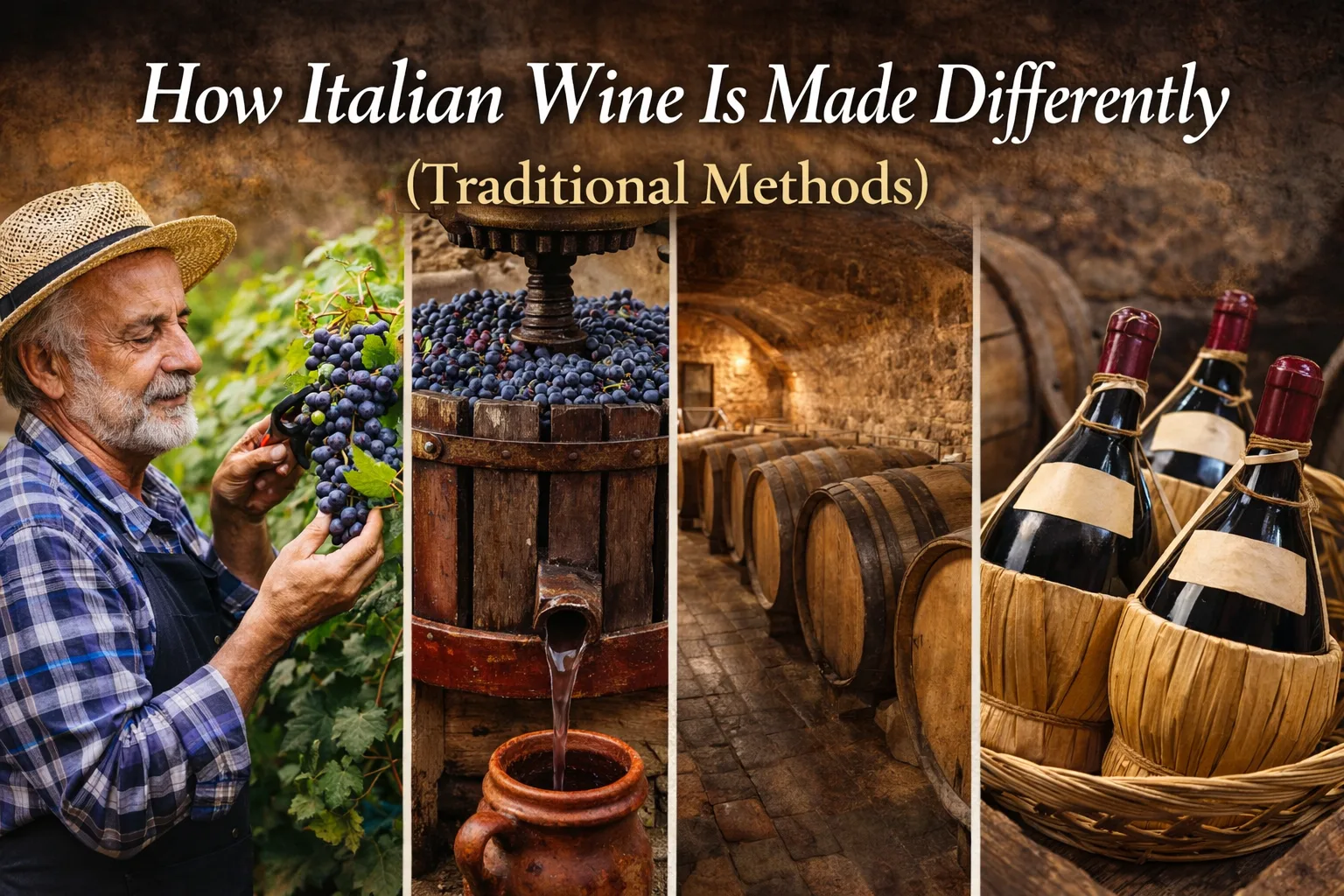
How Italian wine is made differently is the reason it tastes more balanced, food-friendly and distinctive than many modern international wines. In Italy, winemaking has traditionally focused on food, family and place rather than fashion or short-term trends. While modern technology has improved hygiene and consistency, the philosophy behind Italian winemaking has changed very little.
This guide explains how Italian wine is made differently, focusing on traditional methods that are still widely used today and why they matter to UK wine drinkers..
Winemaking in Italy Starts With Food, Not Fashion
One of the biggest differences between Italian wine and many international styles is purpose. In Italy, wine has historically been made to be drunk with food, not tasted in isolation. This single idea shapes almost every winemaking decision.
Rather than chasing high alcohol, extreme ripeness or heavy oak influence, many Italian producers prioritise acidity, balance and drinkability. This approach aligns naturally with British eating habits, which favour hearty meals rather than sweet, fruit-forward wines designed for sipping alone.
Indigenous Grapes Drive Traditional Methods
Italy has more indigenous grape varieties than any other wine-producing country. These grapes evolved naturally alongside local climates, soils and cuisines, long before modern winemaking techniques existed.
Because these grapes are well adapted to their environments, they often require less intervention in the vineyard and winery. This allows traditional practices such as natural fermentation, minimal adjustment and restrained oak use to remain viable today.
In contrast, many international wine styles rely on globally popular grapes that are adapted to new climates through modern techniques rather than tradition.
Fermentation: Time Over Technology
While stainless steel tanks and temperature control are common in Italy today, many producers still ferment wine in ways that prioritise time and patience rather than speed.
Traditional Italian fermentation often involves:
- Slower fermentations at moderate temperatures
- Natural or ambient yeasts rather than selected commercial strains
- Extended contact between wine and grape skins
These methods encourage complexity and texture rather than overt fruitiness. For UK drinkers, this often results in wines that feel more layered and less sweet, even when technically dry.
Oak Is Used With Restraint
In many modern wine styles, oak is a dominant flavour. In Italy, oak has traditionally been a tool rather than a feature.
Large old barrels are still widely used, especially in historic wine regions. These barrels allow gentle oxygen exposure without imparting strong vanilla or spice flavours. The goal is to soften tannins and improve structure, not to mask the grape or terroir.
This restrained approach explains why Italian wines often taste savoury, earthy or herbal rather than overtly oaky — a profile that suits British food exceptionally well.
Blending Is Cultural, Not Commercial
In some wine-producing countries, blending is driven by market demands for consistency. In Italy, blending has historically been about balance and harmony.
Traditional Italian blends combine grapes with complementary traits:
- One for acidity
- One for structure
- One for aroma or colour
These blends were developed long before modern branding, shaped instead by trial, error and local knowledge. This is why many Italian wines feel naturally balanced rather than engineered to hit a specific flavour profile.
Minimal Intervention Is Not a Trend in Italy
Minimal-intervention winemaking is often marketed as a modern movement, but in Italy it is frequently the continuation of old habits.
Many family-run producers have always:
- Used fewer additives
- Avoided heavy manipulation
- Worked with what the vintage provides
This does not mean all Italian wine is “natural”, but it does mean that restraint and respect for the raw material are deeply ingrained in the culture.
For UK buyers, this results in wines that feel authentic rather than manufactured.
Vintage Variation Is Accepted, Not Corrected
One of the most striking differences between Italian wine and mass-market international styles is how producers treat vintage variation.
In Italy, it is normal for wines to taste slightly different from year to year. Weather conditions are seen as part of the wine’s identity rather than a problem to be fixed.
This philosophy contrasts with heavily standardised wines designed to taste identical every year. For drinkers, this adds interest and authenticity, even if it means subtle changes between bottles.
Longer Ageing Is Built Into the Process
Many traditional Italian wines are made with ageing in mind, even if they are released relatively young.
Extended ageing on lees, longer barrel maturation or additional bottle ageing are common practices that prioritise texture and integration over immediate impact. This is why Italian wines often improve with time in the glass and feel more cohesive alongside food.
Family Producers Preserve Methods Others Abandoned
A large proportion of Italian wine production is still in the hands of small, family-run estates. These producers often operate vineyards that have been passed down for generations, preserving methods that would be considered inefficient elsewhere.
Manual harvesting, hand-sorting grapes and small-batch fermentation are still common — not because they are fashionable, but because they are familiar and trusted.
For a specialist merchant, this is a major point of difference compared to industrial wine brands.
Why This Matters for UK Wine Drinkers
Understanding how Italian wine is made differently helps UK buyers choose wines that align with their preferences.
Traditional Italian winemaking tends to produce wines that are:
- Better suited to food
- Lower in excessive alcohol
- Less dominated by oak or sweetness
- More expressive of place and season
These qualities match British dining habits and make Italian wine particularly versatile at the table.
Traditional Does Not Mean Old-Fashioned
It is important to note that tradition does not mean resistance to quality control or hygiene. Modern Italian producers combine centuries-old knowledge with modern tools where appropriate.
The difference lies in intent, not technology. Italian winemaking focuses on preservation and balance rather than reinvention and exaggeration.
Final Thoughts
Italian wine is made differently because it comes from a different mindset. Tradition, food culture and family heritage shape the process as much as science and technology. For UK wine drinkers, this results in wines that feel natural at the table, rewarding over a meal rather than overwhelming it.
By understanding these traditional methods, choosing Italian wine becomes less about memorising regions or grapes and more about trusting a system that has evolved slowly and deliberately over centuries.