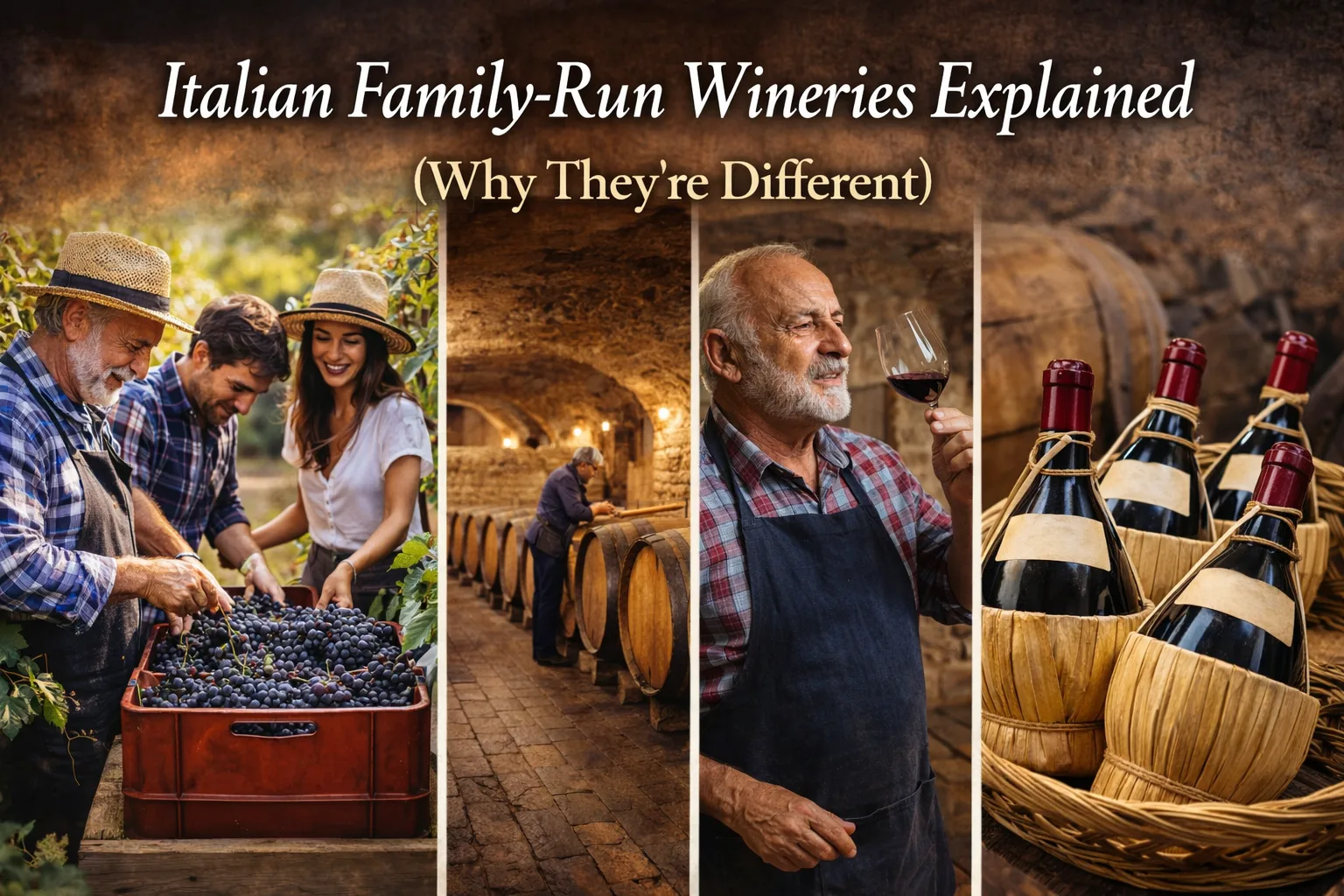
When people shop for Italian wine in the UK, the phrase “family-run winery” appears everywhere. It sounds reassuring, traditional and authentic, yet it is rarely explained in any meaningful way. Over time, the phrase has been diluted into a marketing label rather than a genuine description. In reality, Italian family-run wineries operate very differently from large commercial wine brands, and those differences have a direct impact on how the wine tastes, how it is priced, and how it behaves with food.
This article explains what truly sets Italian family-run wineries apart and why that matters for UK wine drinkers who value authenticity, balance and long-term quality rather than short-term trends.
Family-Run in Italy Means Ownership, Not Image
In Italy, a family-run winery usually means the family owns the vineyards, farms the land themselves, makes the wine on site and sells it under their own name. Responsibility is not outsourced, and neither are decisions. The same family that planted the vines is often the one harvesting the grapes and deciding when the wine is ready to be bottled.
This is very different from many international wine brands, where the “brand” may not own vineyards at all. Grapes are often purchased from multiple growers, blended to a predefined recipe, and produced at scale in industrial facilities. The name on the label represents a marketing identity rather than a direct link to land or people.
In Italy, vineyards are frequently inherited rather than acquired. They are part of family history and future security, not simply a business asset. This creates a mindset that prioritises longevity over fast growth, and stewardship over optimisation.
Decisions Are Made in the Vineyard, Not the Boardroom
Large wine brands are driven by volume targets, cost controls and consistency metrics. Their success depends on delivering the same flavour profile year after year, regardless of weather or natural variation. This often requires intervention, blending across regions, or technical adjustments designed to flatten differences between vintages.
Family-run Italian wineries operate differently. Decisions are guided by the vineyard and the season rather than by spreadsheets. Harvest dates are chosen by tasting grapes rather than hitting sugar targets. Yields are adjusted to protect vine health rather than maximise output. Difficult years are accepted as part of the story, not treated as problems to be engineered away.
For UK drinkers, this explains why Italian wines often feel more alive and more food-friendly. They are shaped by agricultural reality and local culture rather than global market expectations.
Scale Changes Everything
Most Italian family wineries are small by international standards. This scale allows a level of attention that simply is not possible in industrial production.
Smaller estates can hand-harvest grapes rather than rely on machines. Vines can be monitored individually. Disease pressure can be managed thoughtfully rather than chemically. Decisions can be made plot by plot rather than across hundreds of hectares.
Lower yields per vine are common, not because they are fashionable, but because families are thinking in decades rather than quarterly results. Healthier vines produce better fruit over the long term, even if that means less wine in any single year.
While not all family-run wineries are certified organic or natural, many practise low-intervention farming by default simply because they are working land they intend to pass on.
Wine Is Made for the Table, Not the Tasting Room
One of the most important differences between family-run Italian wineries and large brands is intent. In Italy, wine has historically been made to accompany meals, not to impress in blind tastings.
This focus on food influences everything from grape choice to fermentation and ageing. High acidity, moderate alcohol and balanced tannins are valued because they make wine work better alongside food. Excessive ripeness, heavy oak and residual sweetness are often avoided because they dominate the palate.
For British drinkers, this makes Italian family wines particularly well suited to everyday meals. They complement rather than compete, making them easier to drink over the course of a meal rather than in small tasting pours.
Tradition Is Practical, Not Romantic
Traditional methods are often discussed in romantic terms, but in Italy they persist because they work. Large neutral oak barrels are still used widely, not for flavour, but because they soften tannins without masking the grape. Extended ageing is common, not for prestige, but because it improves integration and stability.
Fermentation may be slower, cooler or driven by ambient yeasts, not because it is trendy, but because it suits local grapes and conditions. These practices evolved through trial and error over centuries, long before modern winemaking technology existed.
Family-run wineries preserve these methods because they are familiar and proven. Change happens gradually, not because a market demands it, but because experience suggests it is necessary.
Vintage Variation Is Accepted, Not Corrected
In many large-scale wine operations, consistency across vintages is essential. A wine must taste the same every year so customers know what they are buying. Achieving this often requires blending across regions or technical adjustments that reduce natural variation.
Italian family-run wineries take a different view. Vintage variation is expected and accepted. A hotter year may produce richer wines, a cooler year fresher ones. These differences are not flaws but expressions of the growing season.
For UK drinkers, this adds depth and interest. Wine becomes something to engage with rather than a static product. It also reinforces the sense that the bottle represents a real place and time, not just a flavour profile.
Blending Is About Balance, Not Branding
Blending in Italy is often misunderstood. While international brands may blend to achieve consistency, traditional Italian blending developed to achieve balance.
Different grape varieties were historically planted together to complement one another. One grape might provide acidity, another structure, another aroma. These blends were refined over generations, guided by local knowledge rather than marketing research.
This is why many Italian wines feel naturally harmonious. They were not designed to highlight a single dominant characteristic but to work as a whole, particularly with food.
Economic Pressure Works Differently
Family-run wineries often operate with very different economic pressures to large brands. Growth is usually incremental rather than aggressive. Profit is important, but survival, continuity and reputation matter more.
This means less pressure to chase trends, rebrand frequently or push volume through discounting. Pricing tends to reflect production realities rather than marketing budgets. For UK buyers, this often results in better value wines that prioritise substance over presentation.
It also explains why many family producers are selective about who imports and represents their wines. Relationships matter, and long-term partnerships are preferred over short-term gains.
Family Knowledge Is Accumulated, Not Replaced
In large wine companies, expertise is often centralised and mobile. Winemakers move between regions and brands, applying techniques that are transferable but not always site-specific.
In family-run Italian wineries, knowledge is accumulated over generations. Families understand how specific parcels behave in different conditions, how vines respond to pruning, and how wines evolve with age. This knowledge is rarely written down but passed on through practice.
For drinkers, this results in wines that feel settled and confident rather than experimental or trend-driven.
Why This Matters for UK Wine Drinkers
Understanding what makes Italian family-run wineries different helps UK buyers make more informed choices. These wines tend to be more food-friendly, less manipulated, and more reflective of place. They often sit comfortably at the table and reward attention without demanding it.
They also offer an alternative to heavily branded wines that prioritise consistency over character. For drinkers seeking authenticity, balance and value, family-run Italian wineries provide a compelling option.
Traditional Does Not Mean Outdated
It is important to be clear that tradition does not mean resistance to quality control or hygiene. Modern Italian family producers use contemporary tools where they add value, such as temperature control or improved cellar practices.
The difference lies in intent rather than technology. Tradition is preserved where it works, and modern methods are adopted where they genuinely improve quality, not simply to follow fashion.
Final Thoughts
Italian family-run wineries are different because they operate on a different timescale and with a different set of priorities. Land ownership, food culture, inherited knowledge and long-term thinking shape every decision. The result is wine that feels grounded, balanced and authentic.
For UK wine drinkers, choosing wines from family-run Italian producers is not about nostalgia. It is about selecting wines made with continuity, restraint and purpose, designed to be enjoyed with food and shared over time rather than engineered for immediate impact.